The Real Problem With Learning English Without Speaking Practice
Three years of study, a large vocabulary, solid grammar — and still stuck at hello. Why a study-only routine stalls, and what a ten-minute daily fix looks like.

Consider a learner who has done everything right on paper. Three years of consistent study. A vocabulary app with an unbroken streak. Grammar exercises finished and marked. Films watched in English, songs understood, articles read without difficulty.
Then a colleague from another office visits, says hello, and asks how the project is going. The reply comes out in four words and a long pause.
Nothing was wasted in those three years. But something specific was missing from them, and it is worth naming precisely, because the usual diagnosis — "I need to study more" — makes the problem worse rather than better.
The Problem
Almost every accessible way to learn English trains something other than speaking. Not by conspiracy — because the alternatives are easier to build, easier to measure, and easier to do alone.
- Vocabulary apps train recognition. You learn to identify a word when you see it, which is not the same as producing it unprompted in the middle of a sentence.
- Grammar exercises train analysis with unlimited time. You select the correct form from options, knowing a rule is being tested. Conversation gives you no options and no warning.
- Reading builds comprehension and range beautifully, and requires no production at all.
- Films and series train your ear for natural speech and idiom. Also entirely passive.
- Courses and lessons usually involve some speaking — but in a class of twenty, that is often a few minutes per learner per week.
Every one of these is worth doing. Together they can produce a learner with excellent English who has spoken perhaps a few hours of it in total. That is the problem: not a missing piece of knowledge, but a missing few hundred hours of a particular activity.

Why Does This Problem Happen?
Because a study-only routine is genuinely rewarding, and speaking practice genuinely is not — at least not at first.
Study gives you clean feedback. Cards reviewed, exercises correct, streak intact, level advanced. You finish a session knowing exactly what you did. Speaking practice gives you almost the opposite: an awkward ten minutes, several sentences that came out wrong, no score, and no obvious sign of progress. One of these is much easier to keep doing.
There is also a logistical reason that gets dismissed too quickly. Studying requires a phone and five spare minutes. Speaking traditionally required another human being who was free at the same time, spoke English well enough to help, and did not mind being a practice partner. For most learners that combination barely exists, so the speaking column of the routine stays empty for years — not from avoidance, but from arithmetic.
The Solution
Treat speaking as a separate item in your routine, with its own slot and its own time. Not a reward for finishing your studying, and not something that happens automatically once your grammar is good enough. A line in the schedule, like the vocabulary app.
The version of this that works is smaller than most learners expect. Ten to fifteen minutes a day is enough to change things, and it is short enough to survive a bad week — which matters more than the length, because the mechanism here is accumulation.
One reframe helps a great deal: judge these sessions by whether they happened, not by how well they went. A clumsy ten minutes counts fully. Every stalled sentence is the practice working, because those are the exact places your speech needs mileage.
How Does the Solution Work?
The loop is short and deliberately repetitive:

Most learners run the first step and skip the rest. Adding the other three is what converts knowledge into speech, and the feedback step is what stops you from fluently repeating the same mistake for a year.
A 15-minute daily routine
Minutes 1-2 — warm up out loud
Describe your day so far, or what is in front of you. No preparation, no correcting yourself. This exists only to get you speaking rather than thinking about speaking.
Minutes 3-10 — one conversation on one topic
Pick a single scenario and stay in it: ordering food, explaining your job, giving directions, disagreeing politely. The constraint matters — depth on one topic builds more usable speech than skimming five.
Minutes 11-13 — repeat the hard parts
Find the two or three sentences that came out badly and say each one again, properly, three times. This is the highest-value part of the session and the part everyone skips.
Minutes 14-15 — write down what stalled
One line. A word you could not retrieve, a structure that came out backwards. Over a month this becomes a precise, personal list of what to work on — far better than any generic curriculum.
How Gabfest Helps
The routine above has one practical obstacle: steps two and three need someone to talk to, every day, at whatever hour you are free. That is the requirement that keeps most speaking routines from ever starting.
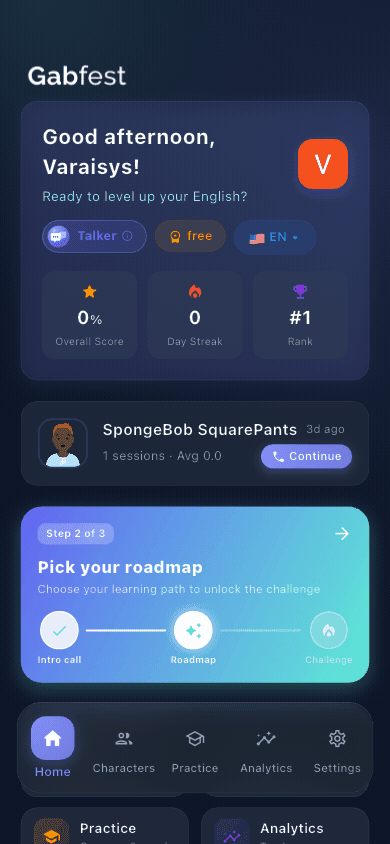
Gabfest is built to remove that obstacle. The pieces that map onto the routine:
- Real-life scenarios — structured situations covering travel, shopping, professional meetings and social settings, which is exactly what step two asks for.
- Voice calls with AI — spoken conversation in real time, with pronunciation feedback as you go.
- Grammar practice tests — topic-based, timed, with instant scoring. Worth keeping, as long as it stays alongside the speaking rather than replacing it.
- Progress analytics and streaks — the visible feedback that study apps provide and raw speaking practice does not, which is a real help in the first few weeks.
- The 3-day rapid challenge — a structured way to get the first three days done, which are the hardest ones.
Key Benefits
What a daily speaking slot changes
- Knowledge you already have starts becoming usable, instead of sitting unconverted.
- You get a specific list of your own weak points, rather than guessing what to study next.
- Speaking English becomes ordinary, which is most of what confidence turns out to be.
- Pronunciation habits get corrected while they are still forming.
- Progress becomes visible in the one place it was previously invisible.
How to Get Started
- Add one line to today's plan: ten minutes of speaking. Do not remove anything else.
- Choose a scenario before you start, so you are not deciding while the clock runs.
- Talk for the full ten minutes even if it is bad. This week is about attendance, not quality.
- Note what stalled. Two words is enough.
- Repeat the same scenario tomorrow. Compare how it feels on day four.
If your obstacle is availability rather than motivation — no partner, awkward hours, nobody to be clumsy in front of — that is a solvable problem now, and how AI can make English speaking practice more accessible goes through how that actually works in practice.
Frequently Asked Questions
Should I stop studying vocabulary and grammar?
No. Study builds the raw material and it is doing its job. The change is additive: keep the studying, add a speaking slot. What does not work is studying instead of speaking and expecting speech to appear on its own.
Is ten minutes a day really enough?
Ten minutes daily is far more effective than seventy minutes once a week, because the effect comes from repeated retrieval rather than total hours. It is also short enough that you keep doing it on bad days, and consistency is the variable that actually predicts progress.
What do I talk about when I practise alone?
Use fixed scenarios rather than free conversation — ordering a meal, describing your work, handling a delayed flight, explaining a problem to a colleague. Scenarios remove the burden of inventing content, so your attention goes to producing the language.
How do I know if I am improving without a teacher?
Track the stalls. If the sentences that stopped you last month now come out cleanly, that is progress, and it is more informative than a test score. Immediate corrections during practice help too — we cover how that feedback loop works separately.
I understand English well. Do I still need this?
Strong comprehension with hesitant speech is the most common profile there is, and it is the clearest sign that speaking practice is the missing piece rather than more study. Why you understand English but struggle to speak it explains why the two skills separate like that.
Conclusion
The real problem with learning English without speaking practice is not that the studying was wrong. It is that the studying was the whole plan, and no amount of it produces a skill it never asked you to perform.
The correction is small and unglamorous: one slot in the day, ten minutes long, where you talk. Keep everything else. Add that.
Put speaking in tomorrow's routine
Ten minutes of real conversation practice with an AI partner, without needing to find anyone to practise with.
Start Speaking with Gabfest