How AI Can Make English Speaking Practice More Accessible
The hardest part of speaking practice has never been the speaking — it is finding someone to practise with. Here is how AI changes that arithmetic, and where it stops.
Ask a group of English learners what stops them practising speaking, and you will hear about confidence, time and grammar. Keep asking and a plainer answer usually surfaces: there is nobody to talk to.
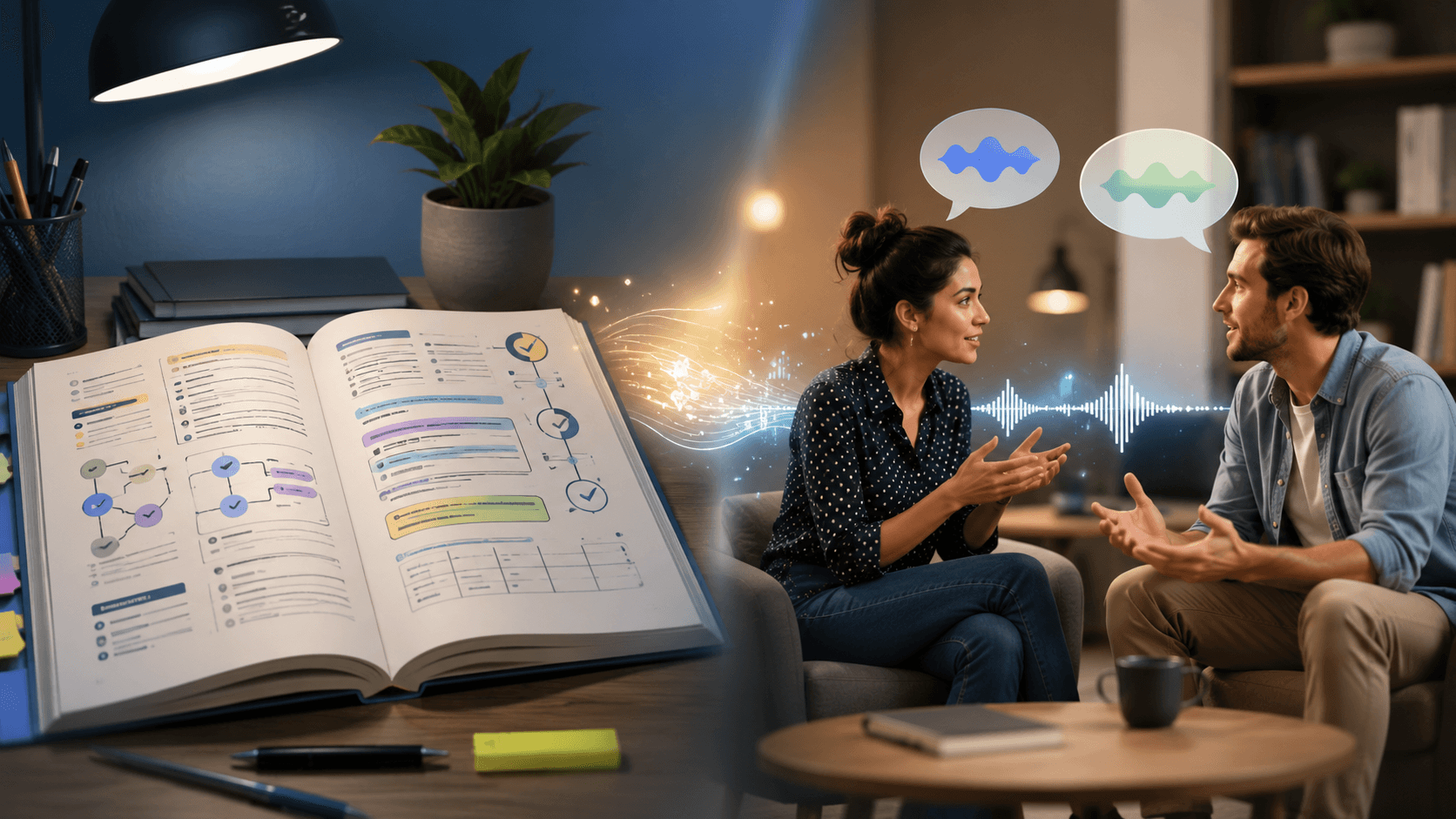
It sounds like a small logistical complaint. It is actually the binding constraint. Reading, listening and grammar drills all scale to a single person with a phone. Conversation has always needed a second party — and that requirement quietly decides whether the most important part of learning a language ever gets done.
The Problem
A conversation partner has to clear an awkwardly high bar. They need to be available when you are free, which for most working learners means early mornings or late evenings. They need English strong enough to be useful. They need patience for repetition, corrections and long pauses. And you need to be comfortable making mistakes in front of them, repeatedly.
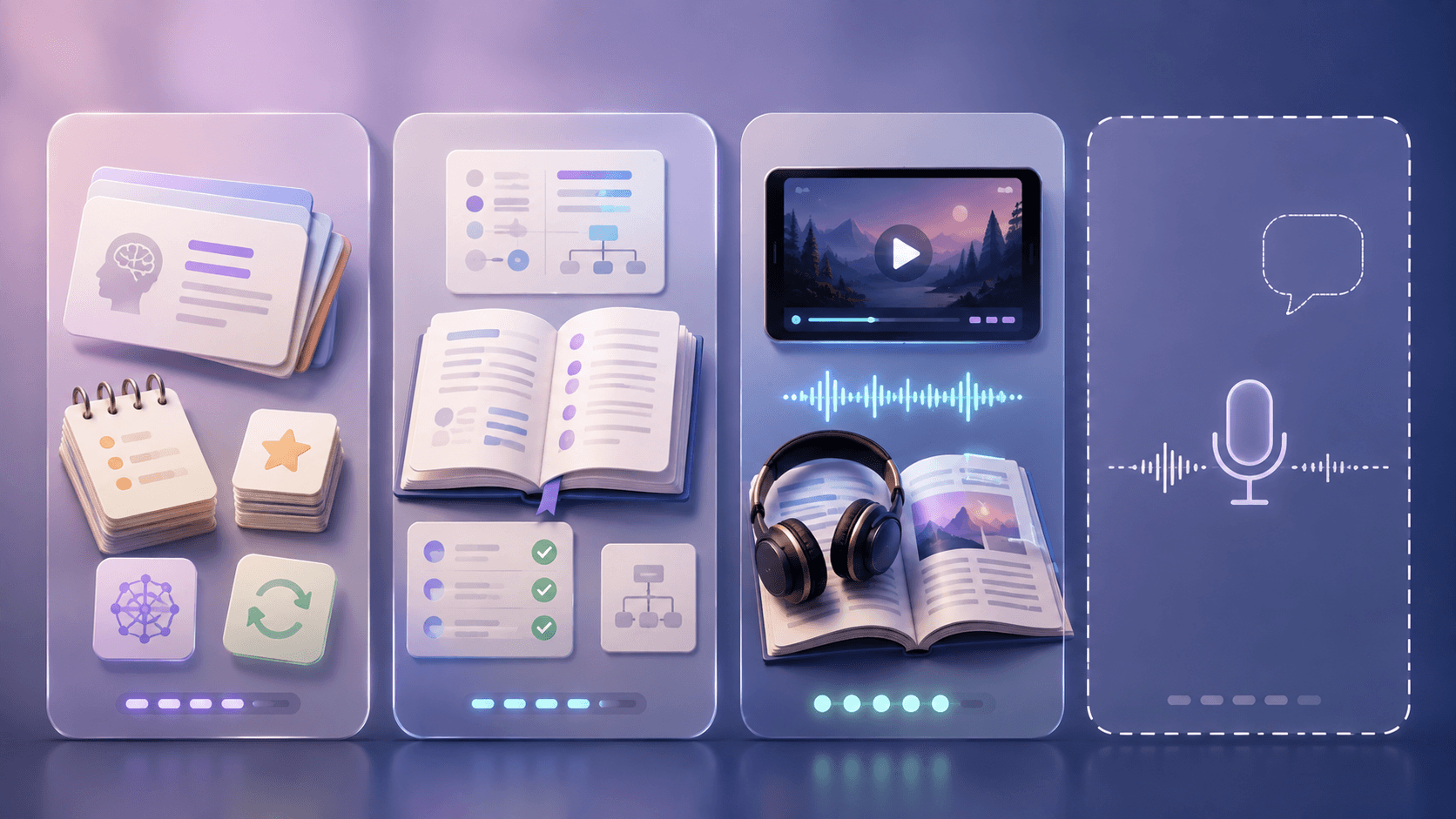
Each condition is reasonable. Together they are demanding enough that most learners never satisfy them. The common substitutes each fail on a different axis:
- A tutor solves quality and patience, and costs money per hour. Fine weekly; usually not viable daily, which is the frequency that matters most.
- A language exchange partner is free, and you spend half the session on their target language while coordinating across time zones and cancellations.
- Friends or colleagues are available and are the people you least want to be clumsy in front of. Conversations also drift back to a shared first language the moment things get effortful.
- Talking to yourself costs nothing and needs no scheduling. It also has no unpredictability and no correction, so you rehearse rather than converse.
Why Does This Problem Happen?
Because speaking practice needs volume, and volume needs availability. Not intensity — availability.
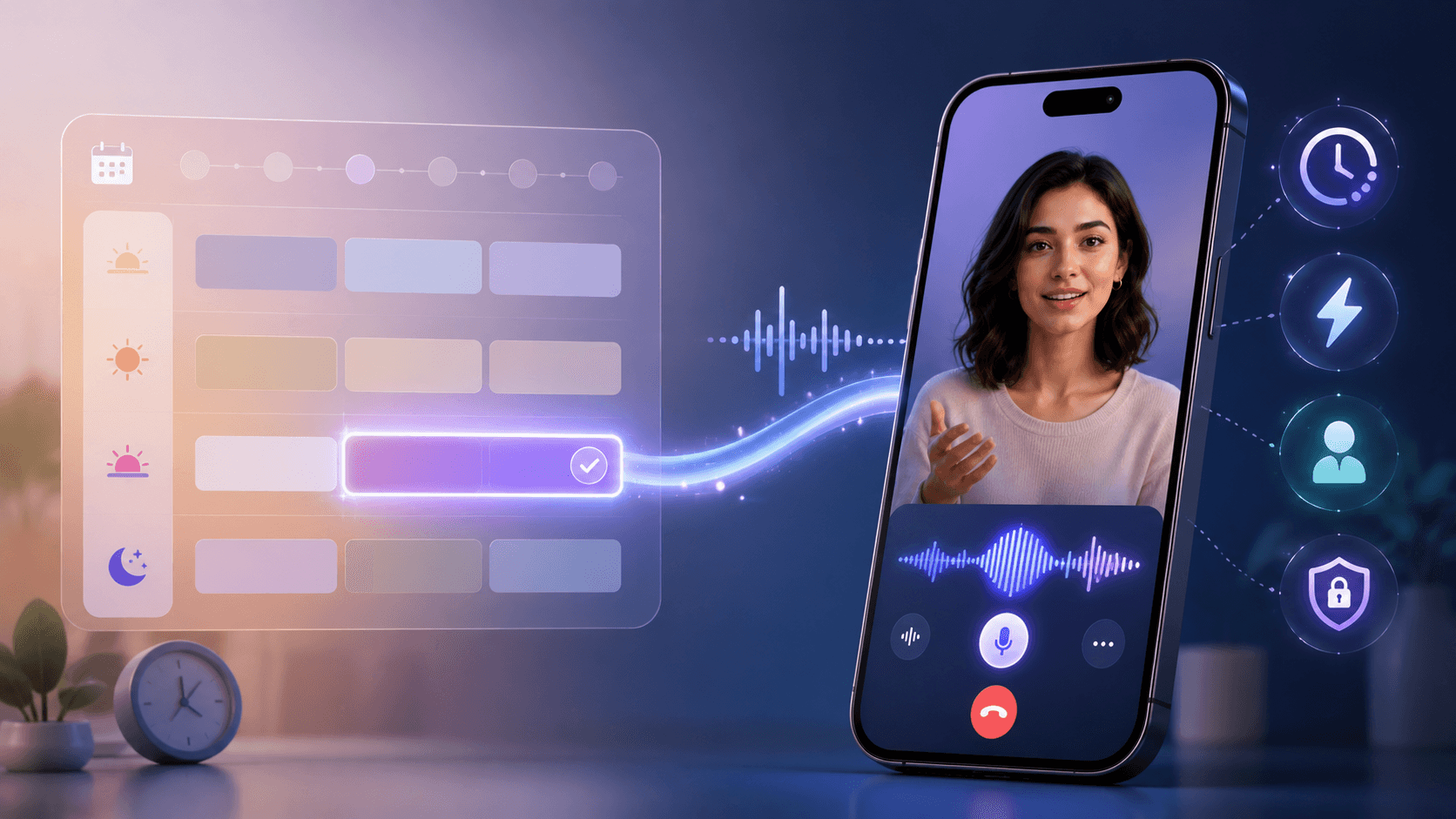
Fluency comes from having produced a pattern often enough that it arrives without assembly. That is a function of repetitions, and repetitions accumulate through frequency. Which means the decisive question is not how good your practice partner is. It is whether a session can happen at 11pm on a Tuesday when you have twelve free minutes.
The Solution
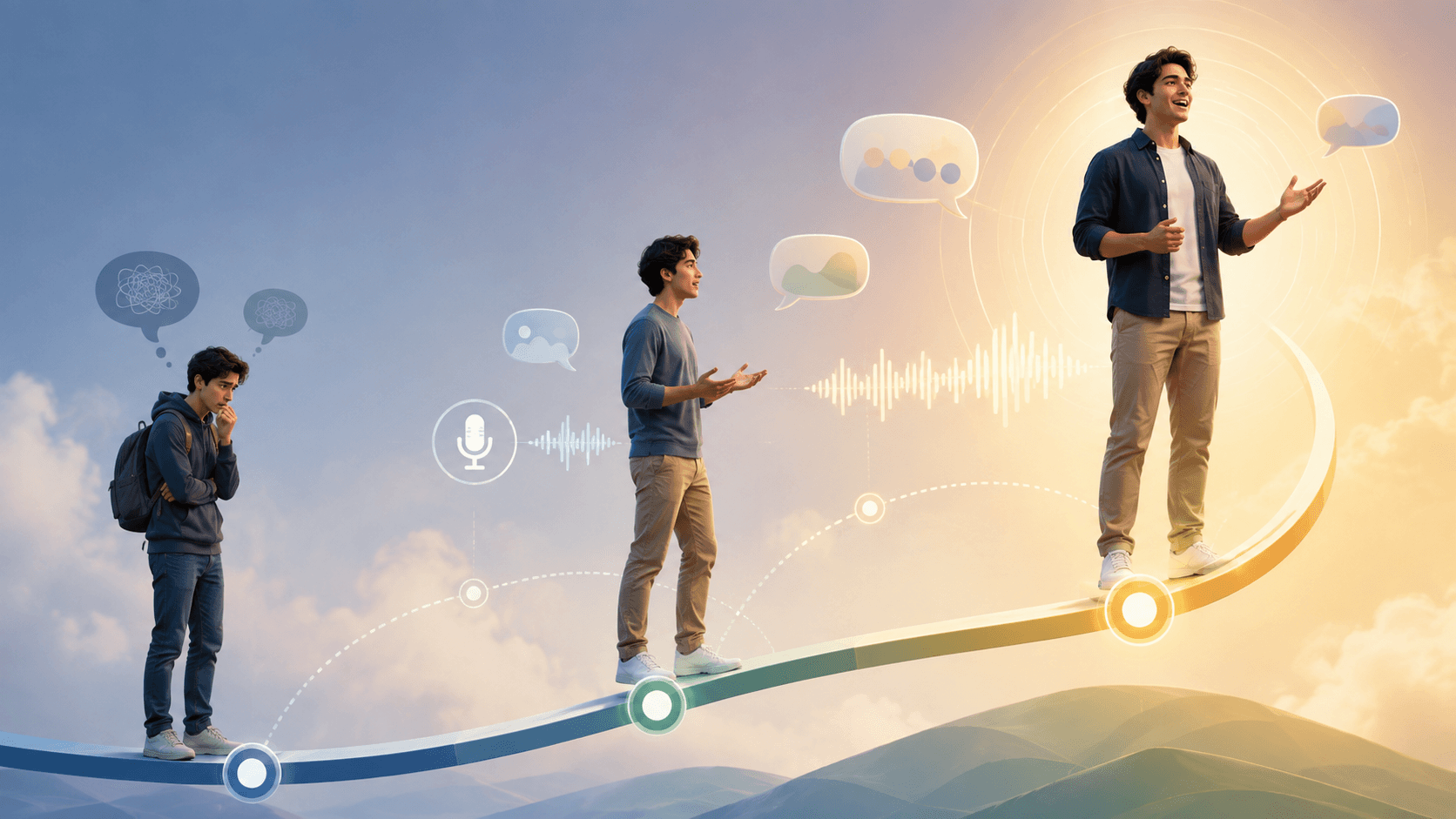
An AI conversation partner does not out-teach a good human tutor. What it does is remove every condition that was blocking frequency: it is available at any hour, it never runs out of patience, it does not need reciprocity, and there is no social cost to a sentence coming out wrong. It converts speaking practice from something you arrange into something you open.
The last of those conditions deserves emphasis, because it changes behaviour more than the others. When a mistake has no audience, you attempt the sentence you are unsure about instead of retreating to the one you can already say. Those attempts are where the learning is — and they are exactly what learners suppress in front of other people.
How Does the Solution Work?
The process is the same loop regardless of which tool you use:
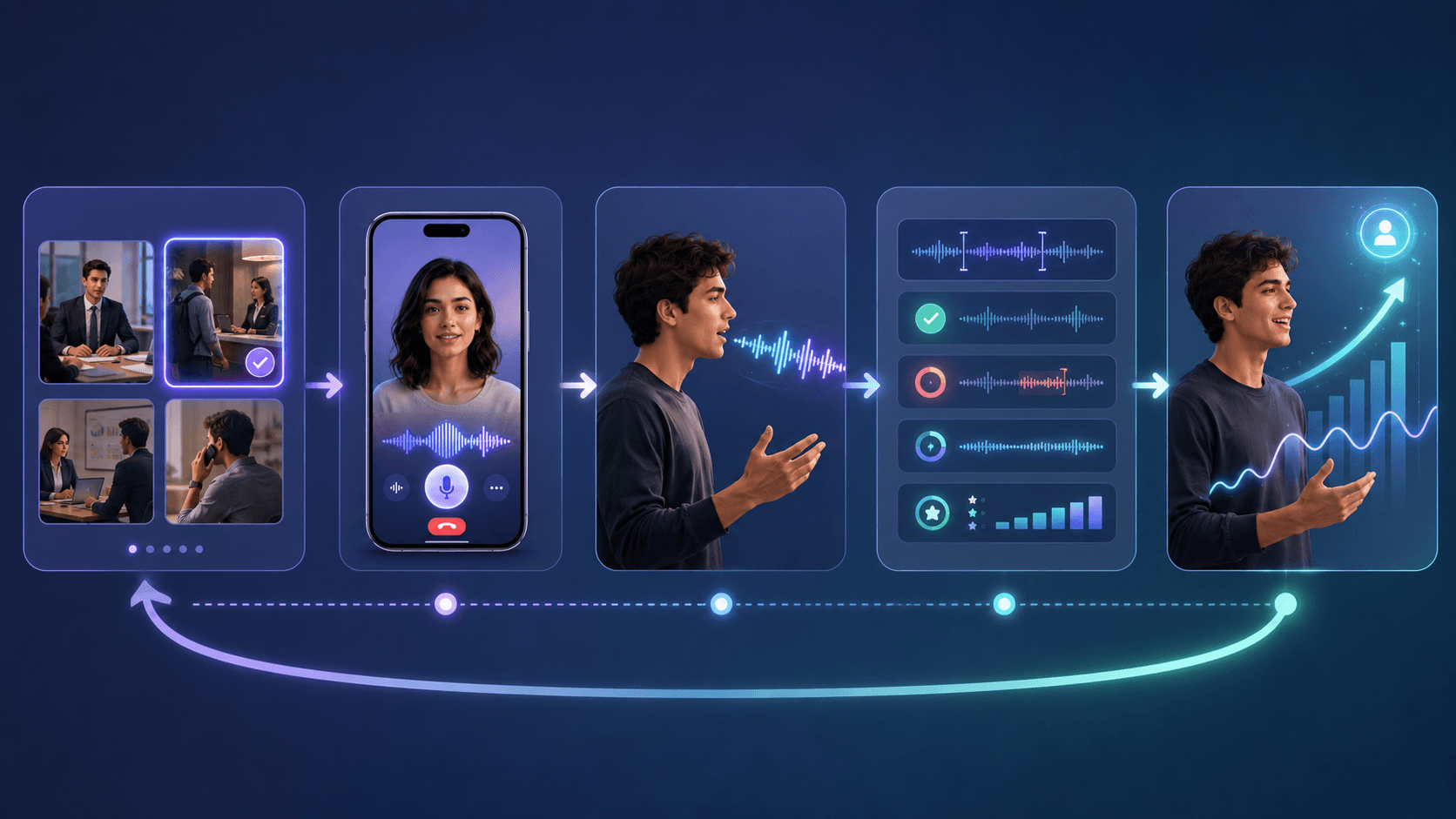
Choose a topic or situation
Pick a concrete scenario rather than free chat — a job interview, checking into a hotel, explaining a delay to a client. A defined situation removes the burden of inventing content, so your attention goes to producing language instead of deciding what to say.
Start the conversation
Begin speaking straight away. Skipping the preparation phase is deliberate: rehearsing in your head first trains composition, and conversation requires improvisation.
Respond naturally
Answer at conversational speed and let the imperfect sentences through. Aim for continuity over accuracy — stopping to correct every article rebuilds the hesitation habit you are trying to remove.
Receive feedback
Find out what actually failed: a mispronounced sound, a wrong tense, a phrase no one uses. Feedback close to the attempt is what makes the difference; the same correction a week later is just information.
Repeat and improve
Run the same scenario again. The second pass is faster, the fourth is noticeably fluent, and that felt progress is what makes the habit stick.
Where AI practice falls short
Being straight about the limits makes the tool more useful, not less.
- An AI is patient in a way people are not. That is the point, and it also means it does not reproduce the pressure of a real interview or a tense meeting. At some stage you need conversations that carry actual stakes.
- Real speakers interrupt, mumble, use regional slang and change subject unhelpfully. Practising with a partner who is consistently clear leaves that unpredictability untrained.
- Feedback on pronunciation and grammar is genuinely useful and not infallible. Treat it as a strong signal rather than a verdict.
- It will not teach you to read a room — when to be indirect, how much warmth a greeting needs. That is cultural knowledge, and it comes from people.
The sensible reading: AI practice is how you build the volume, and human conversation is how you pressure-test it. Most learners need far more of the first than they are getting.
How Gabfest Helps
Gabfest is one implementation of that loop. Mapping its parts onto the five steps above:
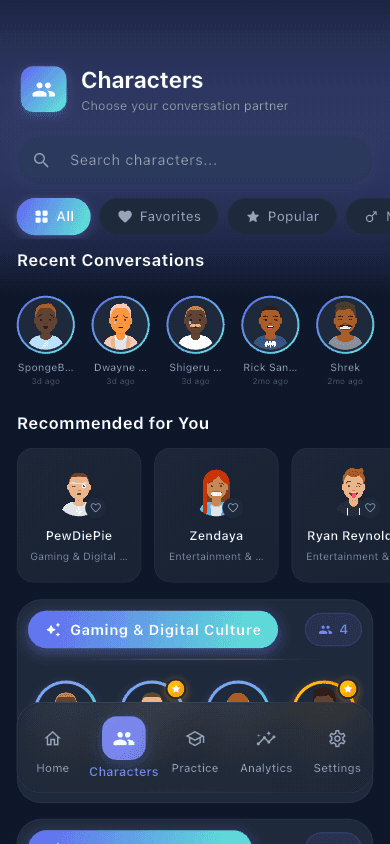
- Scenarios and 100+ AI characters — covers step one. Different personalities and difficulty levels matter because adapting to an unfamiliar speaker is part of the skill.
- Voice calls — steps two and three, in real time with audio streaming, so you are responding rather than composing.
- Pronunciation and grammar feedback — step four, close enough to the attempt to change the next sentence. Pronunciation training adds phoneme-level detail when a specific sound is the problem.
- Progress analytics and streaks — step five, which is mostly a motivation problem. Seeing the count rise is what carries you through the first weeks.
- Text conversations — a quieter entry point for a crowded train or a shared room, with corrections as you type.
- Interview practice — the closest thing to rehearsing under pressure, for when a real conversation is coming and you want the mistakes made beforehand.
The complete list lives on the features page. The important part is the loop, not the feature count — any tool that lets you run those five steps daily will do more for your speaking than a better tool you use monthly.
Key Benefits
What changes when practice is always available
- Practice stops requiring coordination, so it survives busy weeks instead of collapsing.
- You attempt sentences you are unsure about, because a mistake costs nothing.
- Feedback arrives while the attempt is fresh, which is when it changes anything.
- Repeating a scenario is free, and repetition is what makes speech automatic.
- Daily fifteen-minute sessions accumulate into a volume of practice that weekly lessons cannot reach.
How to Get Started
- Choose the scenario you most expect to face in real life. Relevance keeps the habit alive better than novelty.
- Do twelve minutes. Speak continuously; do not stop to correct yourself mid-flow.
- Read the feedback once, pick a single thing, and ignore the rest.
- Run the same scenario again tomorrow with that one thing in mind.
- After a week, switch scenarios and notice how much less effort the setup takes.
Frequently Asked Questions
Is practising English with AI actually effective?
For building fluency and reducing hesitation, yes — those come from repeated production with quick feedback, which is precisely what an AI partner can provide at volume. For cultural nuance and real social pressure, human conversation is still necessary. Use AI for the mileage and people for the stakes.
Will an AI correct my pronunciation reliably?
It will flag sounds that deviate from the expected pronunciation and give you a model to compare against, which is genuinely useful for the sounds your first language does not contain. It is a strong signal rather than a perfect judge, so treat a persistent flag as worth investigating and an isolated one as noise.
Do I need a good level of English to start?
No, and waiting is counterproductive — the ability to hold a conversation is built by holding conversations. Start with simple scenarios and a partner set to an easy difficulty level. If nerves rather than level are the real obstacle, that is a different problem with a different fix.
How is this different from talking to myself?
Two things: unpredictability and correction. Talking to yourself lets you rehearse sentences you have already decided on, and never tells you when one is wrong. A conversation makes you respond to something you did not plan for, which is the part that transfers to real situations.
Should I still find a human conversation partner?
Eventually, yes. Think of AI practice as the training and human conversation as the match. The mistake is waiting until you feel ready for the match before doing any training — which is the same trap as waiting for perfect English before speaking at all.
Conclusion
AI has not made speaking practice better in some abstract sense. It has made it available — at 6am, at midnight, for twelve minutes, without arranging anything with anyone. Given that availability was the constraint blocking most learners entirely, that turns out to be the change that matters.
The loop is unchanged: choose a situation, speak, get corrected, go again. It was always the right method. It is just no longer conditional on somebody else being free.
Try one AI conversation today
Pick a scenario, speak for ten minutes, and see what the feedback tells you. No scheduling required.
Practise with an AI Partner